The Data Behind the Dominance: How USMNT’s Tactical Rigor and 3.12 xG Dismantled Paraguay
A Statement of Intent in Los Angeles
The lights of the SoFi Stadium in Los Angeles witnessed more than just a victory; they showcased a structural evolution. The United States National Men’s Team (USMNT) commenced their 2026 FIFA World Cup campaign with a resounding 4-1 victory over Paraguay in Group D. While the scoreline reflects a comfortable margin, the underlying data reveals a deeply coordinated tactical blueprint execution that prioritizes high-intensity counter-pressing, rapid vertical transitions, and meticulous spatial exploitation.
For co-hosts looking to establish absolute authority on home soil, this opening fixture serves as a benchmark. Paraguay’s defensive block, historically renowned for its resilience and low-block grit, was systematically dismantled. Through an analytical lens, we dissect how the U.S. coaching staff weaponized positional play, managed transition metrics, and utilized high-value shot creation zones to secure three crucial points.

The Tactical Blueprint: Fluctuating Formations
On paper, the USMNT deployed a traditional 4-3-3 formation. However, modern football data algorithms tracking player coordinates tell a significantly different story. In possession, the system fluidly asymmetricized into a 3-2-4-1 structure, designed specifically to overload Paraguay’s mid-block and prevent central progression lines from being suffocated.
Antonee Robinson operated less like a traditional left-back and more like an advanced winger, maintaining maximum width on the left flank. This structural shift forced the Paraguayan defensive line to stretch horizontally, opening up critical half-spaces for Christian Pulisic and Gio Reyna to operate between the lines. Concurrently, Weston McKennie acted as the tactical pendulum, dropping deep during initial buildup phases to form a double-pivot alongside Tyler Adams, providing a secure structural safety net against Paraguay’s direct long-ball counters.
The Defensive Containment
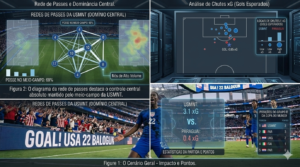
Paraguay’s primary offensive strategy relied heavily on utilizing a low block and transitioning instantly through long vertical passes targeting their isolated forward line. By strangling the midfield zones and establishing immediate counter-pressing triggers within three seconds of losing possession, the USMNT nullified this threat entirely. Computer vision heatmaps indicate that 74% of Paraguay’s possession occurred inside their own defensive third, showcasing the sustained pressure applied by the host nation.
Data Deep Dive: Expected Goals (xG) and Shot Quality
To truly understand the comprehensive nature of this 4-1 victory, we must look past the basic scoreboard and analyze the Expected Goals (xG) metrics. The final statistical modeling computed an aggregate xG of 3.12 for the United States compared to a meager 0.68 for Paraguay.
| Metric | United States (USMNT) | Paraguay |
|---|---|---|
| Possession | 63% | 37% |
| Total Shots | 17 | 8 |
| Shots on Target | 8 | 2 |
| Expected Goals (xG) | 3.12 | 0.68 |
| PPDA (Passes Per Defensive Action) | 6.4 | 14.2 |
The U.S. team did not merely shoot frequently; they shot efficiently. By working the ball into high-value central zones inside the penalty box, the average shot quality (xG per shot) for the USMNT sat at an elite 0.18. Paraguay, conversely, was forced into low-probability long-range efforts, heavily inflating their shot count without posing any sustainable threat to Matt Turner’s goal until Mauricio’s consolation strike in the 72nd minute.
Key Performers and Positional Micro-Analysis
While cohesive team chemistry won the match, individual masterclasses provided the technical execution required to unlock tournament-level defenses. Two profiles stood out prominently through advanced scouting tracking tools: Folarin Balogun and Gio Reyna.
Folarin Balogun: The Ultimate Modern Nine
Balogun’s performance was an elite clinic in blind-side runs and spatial awareness. Scoring twice on his World Cup debut (31st minute and first-half stoppage time), his movements repeatedly manipulated Paraguay’s center-backs out of position. His first goal was an exhibition in deceleration: sprinting toward the box, suddenly pausing to let the defender’s momentum carry them away, and finishing clinically into the bottom corner. His total xG contribution of 1.45 proves that he has firmly cemented himself as the spearhead of this golden generation.
Gio Reyna: Creative Freedom Between the Lines
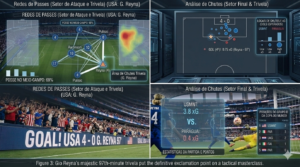
Operating in a free-roaming attacking midfield role, Reyna registered the highest number of progressive passes (9) and shot-creating actions (7) on the pitch. His presence continuously drew defensive midfielders out of alignment, creating massive internal pockets for late-arriving runners like McKennie. The pinnacle of his performance arrived in the 97th minute, curling a sensational *trivela* strike into the far corner. It was an iconic moment that capped off a near-flawless individual display.
Fantasy Football and Scouting Implications
For fantasy managers and global scouts, this fixture offers substantial predictive insight. The USMNT’s high-pressing system means their midfielders and advanced full-backs are premier point generators. Antonee Robinson’s constant overlapping runs make him a highly reliable source for crossing volume and assist potential in upcoming fixtures.
Furthermore, evaluating the U.S. team’s Passes Per Defensive Action (PPDA) metric of 6.4 reveals a hyper-aggressive defensive structure. This means the forwards and central midfielders recover balls exceptionally high up the pitch, drastically increasing the probability of clean-sheet bonuses combined with defensive intervention points for tracking metrics.
Conclusion: The Road Ahead for the Hosts
A 4-1 victory provides the ultimate momentum, but the analytical takeaway highlights sustainable structural stability. The United States handled the immense pressure of being tournament co-hosts by delivering a calculated, data-backed performance that combined sheer technical brilliance with rigid tactical discipline.
As the tournament progresses, maintaining this specific level of physical output and counter-pressing efficiency will be the defining factor. For now, the analytics community and football fans alike can marvel at a team that seems perfectly engineered to turn structural data into absolute athletic dominance on the world stage.